
What Does It Mean to Abide in Christ?

Does the idea of abiding in Christ seem like an abstract or elusive concept to you? Are you overwhelmed by the weight of good works in your Christian walk? I shared a bit about some of these struggles in my own life with my email subscribers and that my focus in this season is simply to abide in Jesus. So I began to wonder, what does it really mean to abide in Christ? What should that look like in our daily lives? In this post, we will dive into John 15:1-11 and explore the answer to this question.

Scripture

Context

Just before this passage, Jesus washed His disciples’ feet and exposed Judas as the one who would betray Him. This ultimately led to Christ’s crucifixion (John 13). After that, Jesus went on to affirm that He alone is the Way, the Truth and the Life. And, He promised the Holy Spirit would be the disciples’ Helper (John 14). Jesus knew that He would soon face crucifixion. And, our passage includes some of the last words He spoke to His disciples before that took place. In John 15:1-11, Jesus is speaking to His disciples (minus Judas)—preparing them for the trials and sorrow ahead. With that in mind, let’s read our passage.

John 15:1-11 ESV

“I am the true vine, and my Father is the vinedresser. Every branch in me that does not bear fruit he takes away, and every branch that does bear fruit he prunes, that it may bear more fruit. Already you are clean because of the word that I have spoken to you. Abide in me, and I in you. As the branch cannot bear fruit by itself, unless it abides in the vine, neither can you, unless you abide in me. I am the vine; you are the branches. Whoever abides in me and I in him, he it is that bears much fruit, for apart from me you can do nothing. If anyone does not abide in me he is thrown away like a branch and withers; and the branches are gathered, thrown into the fire, and burned.

If you abide in me, and my words abide in you, ask whatever you wish, and it will be done for you. By this my Father is glorified, that you bear much fruit and so prove to be my disciples. As the Father has loved me, so have I loved you. Abide in my love. If you keep my commandments, you will abide in my love, just as I have kept my Father’s commandments and abide in his love. These things I have spoken to you, that my joy may be in you, and that your joy may be full.” — John 15:1-11 ESV (divided in two paragraphs for easier reading)

Digging Deeper

The Word “Abide”

Given that Jesus’s primary command in this passage is “abide in me” it’s important that we understand the meaning of the word abide. The original Greek word is menō (pronounced men’-o), which simply means to remain. But, it can be used in several contexts, which adds depth to the meaning of the word. Some of the more nuanced definitions are: to be held or kept continually, not to perish, to last, endure, live, and to remain as one.1

The Meaning of This Passage

In this passage, Jesus is telling His disciples to remain in Him. Ultimately, explaining the nature of genuine salvation by using a word picture.2 He explains that He is the Vine. God the Father is the Vinedresser (or Farmer) and there are two types of disciples who are the branches. The first kind of branch (or disciple) is like Judas—one that does not bear fruit and is cut off from the Vine and thrown into the fire (hell). The second kind of branch is one that’s firmly attached to the Vine. It’s nourished by the Vine, bearing fruit. And, the Vinedresser prunes it so that it can bear more fruit.

To be clear, Jesus is not implying that someone can lose their salvation. There are many verses throughout Scripture that confirm once a person is born again, they are saved once and for all. There are no “take backs” when God gives the gift of salvation. Instead, Jesus is explaining that “disciples” like Judas who ultimately reject Him were never true disciples in the first place. Those who are truly saved bear fruit. 

But, it’s not up to us to produce our own fruit. We must be attached to the Vine for life and pruned by the Vinedresser. As I reflect on this, I am looking at the maple tree growing outside my window. It doesn’t bear fruit, but if I were to cut off a branch, the leaves would wilt and the branch itself would get brittle and die. A branch cannot hope to survive, or turn vibrant red in the fall, or grow leaves again in the spring without the life of the tree. We need to have a similar mindset about life and works.

What fruit looks like

If bearing fruit in the Christian life is as important as Jesus says it is, we must understand what fruit looks like. Thankfully, God explains this to us through the Apostle Paul in Galatians 5:22-23. “But the fruit of the Spirit is love, joy, peace, patience, kindness, goodness, faithfulness, gentleness, self-control.” All other good works flow from this fruit.

The world today is filled with messages to love your neighbor, be kind, and do good. But if these are fruits of the Spirit, can they truly be accomplished apart from Christ as many attempt to do? A branch cannot will itself to bear fruit. Only the Vine and the Vinedresser have any real control over whether or not a branch bears fruit.

So how do we abide in Christ? Thankfully, Jesus makes this clear to us if we listen carefully.
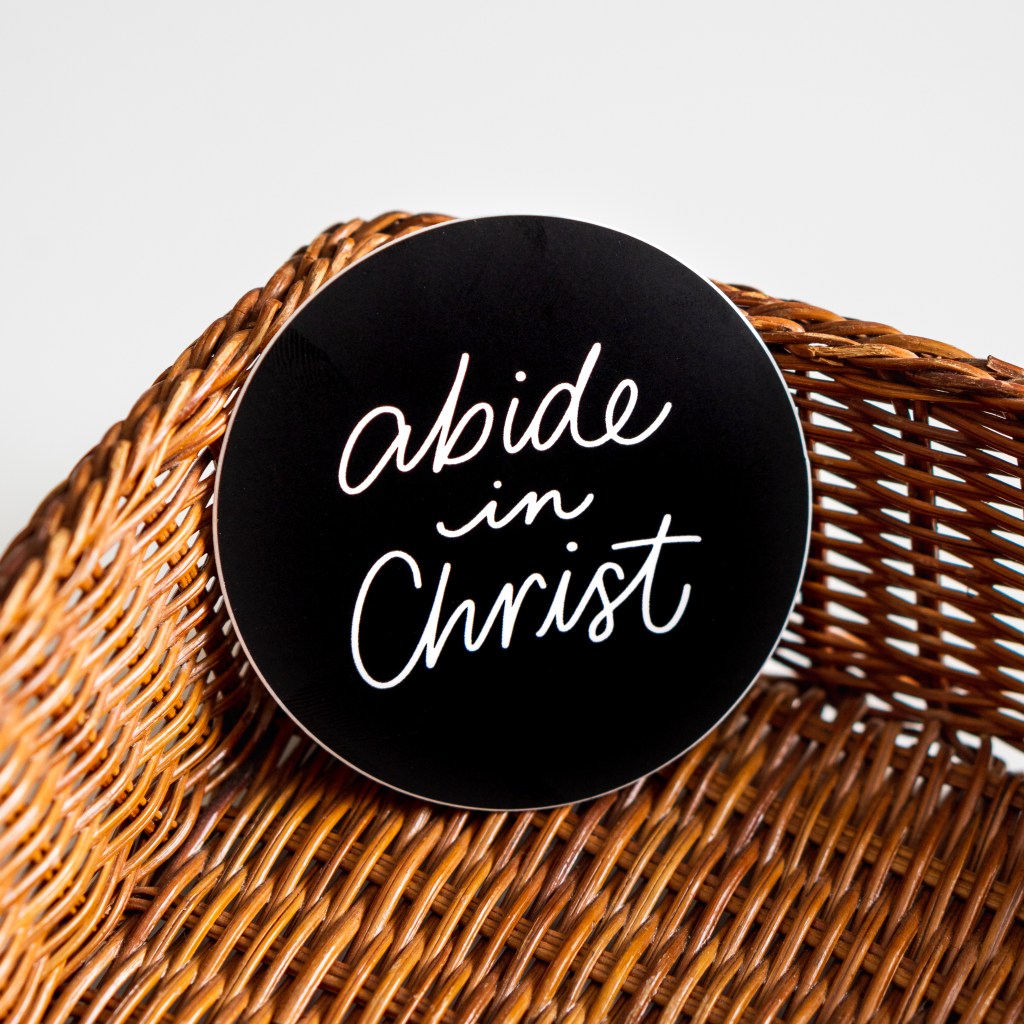
Abide in Christ Sticker
Scripture Memory Cards

Application

Abiding in Christ means having faith in Him alone.

Again, the primary message Jesus is communicating is that salvation is found in Him alone. To abide in Him is to repent and believe in the gospel. The gospel is the good news that while we were guilty and dead in our sins, God the Father lovingly sent His Son to die on a cross and rise from the dead for the forgiveness of sin so that we could be declared righteous in God’s sight, receive the gift of eternal life, and not fear judgment and wrath on the day Christ returns. (Mark 1:15, Romans 5:6-11) (Read this post for more details on the gospel.)

Jesus forgives us out of His abundant grace when we put our faith in Him. Faith isn’t an abstract concept. Jesus is very clear throughout Scripture that to believe in Him is to trust in Him alone as God, Savior, and Lord of our lives. It also means we repent, which is to confess our sins, turn from them and towards Christ. It’s to surrender to His will for our lives. I’ve heard it said that faith and repentance are two sides of the same coin. You can’t have one without the other. (To learn more, read this post.)

Important questions

Have you repented of your sins and trusted in Jesus as Lord and Savior of your life? If so, what fruit has receiving the gift of salvation produced in your life? If you’re struggling to see fruit in your life, why might that be? I encourage you to prayerfully ask the Lord to reveal the fruit in your life if there is fruit. And if there’s not, ask Him to show you why that is. If you have not yet put your faith in Christ, will you do so today? All God requires is repentant faith. He wants a relationship with you and you can start pursuing Him today!

Abiding in Christ means we abide in His Word.

John 15:3 reveals we are saved by hearing the Word. And, John 15:7 indicates that abiding in Christ and abiding in His Word go hand-in-hand. One commentator I listened to likened the Word of God to the knife the Vinedresser (the Father) is holding. This passage, along with Hebrews 4:12 supports this analogy. His Word is “sharper than any two-edged sword, piercing to the division of soul and of spirit, of joints and of marrow, and discerning the thoughts and intentions of the heart.” Likewise, Spurgeon said that “It is the Word that prunes the Christian.” The more we know the Word, the more we love the Word, and the more we allow the knife to do its work.3

Do you believe that the Bible is God’s written Word to us? Do you believe all of it is perfect and without error? If so, how has that belief impacted your life? If not, what do you struggle to believe and why? Ask God to help you understand His Word rightly.

And, are you regularly reading the Bible? Are you studying it? Do you seek to know and love God more deeply through His Word? Consider the impact His Word is having or could be having on your life by abiding in His Word daily.

Abiding in Christ means we obey Him.

As God produces fruit in us scripturally, He develops the fruit of obedience within us. And, He uses our obedience to produce more fruit. Oftentimes, we jump straight to obedience by doing good works. But, when this isn’t a result of faith in Christ and faithfulness to His Word, it doesn’t bear good fruit. Instead it leads to striving and spiritual burnout. And at worst, it even leads some to have false assurance of salvation. The question we must ask ourselves is: Do I have more faith in my works or in Jesus to save me? Only Jesus saves. Or perhaps you’re like me and you know Christ alone saved you, but you still fall into doing and striving that leads to burnout. If that’s you, consider: Am I trusting that I already have God’s favor because of Christ’s righteousness given to me?

And finally, do you pray for the Holy Spirit to help you walk in obedience? If we aren’t living Spirit-led lives, we will attempt to do far too much in our own strength. Our passage comes right after Jesus promises the Holy Spirit in John 14:15-31. Jesus was communicating that relying on the Holy Spirit is critical to abiding in Him.

Abiding in Christ means we have joy.

The disciples didn’t understand it yet, but Christ was preparing them for His death and resurrection as He spoke the words in John 15:1-11. In John 15:11, Jesus communicates that He revealed all of this so “that my joy may be in you, and that your joy may be full.”

Considering this passage, what does it mean to be filled with Christ’s joy? Examine your own heart and life. Are you a joy-filled Christian? How might reflecting more on the gospel increase your joy? What might it look like for you to be filled with joy, even in the midst of hardships and grief? If joy is lacking in your life, how might this passage be speaking into the reason why? 

Conclusion

When we abide in Christ, He bears fruit in our lives. This glorifies Him and blesses us and those around us. 

So, as I consider what it means to live my own life abiding in Christ as a born again believer, I know that it means I must continue pursuing Jesus faithfully through His Word and obedience by the power of the Spirit. In doing so, I can joyfully trust Jesus and the Father to prune and bring forth fruit in my life.

Before you close this window, consider: How is God prompting you to abide in Him?

Notes


Permissions

Unless otherwise indicated, scripture quotations are from the ESV® Bible (The Holy Bible, English Standard Version®), Copyright © 2001 by Crossway, a publishing ministry of Good News Publishers. Used by permission. All rights reserved. May not copy or download more than 500 consecutive verses of the ESV Bible or more than one half of any book of the ESV Bible.

All About Bible Translations

What do you know about Bible translations? Perhaps you prefer a particular translation, but do you know why? It may seem like an irrelevant topic to some. But, having a basic knowledge about Bible translations is foundational to spending quality time with God in His Word and accurately understanding and interpreting Scripture. In this post, we’ll talk briefly about how the Bible is translated. Then, we’ll talk about the two main Bible translation philosophies and where several popular Bible translations fit within those approaches.

How the Bible is translated

To begin on the topic of Bible translations, it’s important to understand that quality, trustworthy translations are not based on a certain individual or group’s own unique interpretation of Scripture. 2 Peter 1:20-21 says, “that no prophecy of Scripture comes from someone’s own interpretation. For no prophecy was ever produced by the will of man, but men spoke from God as they were carried along by the Holy Spirit.” Sound translators recognize this reality. They seek to communicate God’s intended message to us by translating Scripture from the original languages into English in a way that’s true to the original text, while also being understandable to readers. We’ll get into more of that in the next section. But, if you’d like to do more reading on the history of the Bible in English, read this great article.

The two philosophies

There are two primary philosophies or approaches to Bible translation: word-for-word and thought-for-thought (also referred to as “literal” and “dynamic”). Word-for-word translations try to remain true to the wording and structure of the original languages, while also remaining clear to understand. Thought-for-thought translations are more liberal with wording and structure in order to emphasize clarity and understandability without sacrificing accuracy.

Which translation should you read?

Maybe you already have your favorite Bible translation picked out. If that’s the case, I encourage you to do a bit more research on that translation to learn why you like it. Is it word-for-word, thought-for-thought, or somewhere in the middle? 

Or maybe you aren’t sure what Bible translation you prefer. If that’s the case, I encourage you to compare translations. Next time you sit down to read or study the Bible, read the same passage in multiple translations on the Bible app or on Bible Gateway. They are free to access and a simple way to discover the differences between translations and which you prefer.

Regardless of your preferences or knowledge of Bible translations, reading multiple translations can be a great way to study the Bible to gain a more well-rounded understanding of God’s intended meaning. Just be sure you are reading solid and trusted translations. Not all translations included on the Bible app or Bible Gateway are sound or accurate. I’ve included a short list of popular trusted Bible translations below (as well as a couple to avoid). But if you are interested in learning more about how to determine whether or not a translation can be trusted, this article is very helpful.

A few of the most popular and trusted Bible translations

King James Version (KJV)

This old and trusted translation was published in 1611. The goal was to bring the Word of God to His people in a language they’d be able to understand. The KJV blends transparency, as well as the original form and structure of the Bible documents that were available at the time. It’s perhaps best known for its beautiful 17th-century English. But, it’s often challenging for modern readers to understand. (Read more about the KJV here.)

New King James Version (NKJV)

The publisher released the NKJV in-full in 1982. The translators prioritized transparency and used the same source documents as the KJV. Since translators updated the English, it’s easier for the average reader to understand. (Read more about the NKJV here.)

New International Version (NIV)

The NIV was first released in-full in 1978 and has remained a popular translation to this day. The goal of the translators was to recreate a reading experience that closely resembled the experience the original audience would have had. According to the publisher, translators used the best-attested manuscripts. They sought to balance the form and structure of the original language with understandability to communicate the original meaning of each verse. (Read more about the NIV here.)

English Standard Version (ESV)

Crossway published the ESV in 2001. It’s considered an “essentially literal” translation that’s still easy for today’s readers to understand. It prioritizes transparency to the form and structure of the original documents. For many Bible readers, the ESV is a favorite because it’s more literal than the NIV, but more readable than the NASB. (Read more about the ESV here.)

New American Standard Bible (NASB)

The goal of the NASB translators was to remain as true to the original documents as possible, while still remaining comprehensible in English. The publisher released it in 1971 and it was a favorite translation among Bible students for many years. (Read more about the NASB here.)

New Living Translation (NLT)

Over 90 evangelical Bible scholars worked together to release the NLT in 1996. The goal was to communicate the original meaning while remaining accurate to the original text. (Read more about the NLT here.)

Christian Standard Bible (CSB)

The goal of the CSB translators was to produce an accessible English translation that was true to the original documents. The publisher originally called it the Holman Christian Standard Bible (HCSB) in 2004. But when they updated the text in 2017, it simply became the Christian Standard Bible. The publisher brought together an international team of 100 scholars from many denominations—all committed to the inerrancy of the Bible. (Read more about the CSB here.)

Shop Bookmarks to Help Your Bible Study
Shop Bible Studies You Can Trust

Proceed with caution 

The Message (MSG)

I debated on whether or not to include The Message (MSG) on this list because it’s not technically a translation. Therefore, it’s not technically the Bible, but because of its popularity, I included it here. The Message is said to be a paraphrase written by one man named Eugene Peterson. Proceed with caution whenever a translation or paraphrase is written by an individual instead of a committee. Accountability comes into question and there is much more room for error and personal bias.

I have heard conflicting views from respected Bible teachers on whether The Message should be entirely avoided or if it can be helpful supplemental material in one’s own personal studies. Considering this, The Message should not be used as one’s primary Bible translation. I tend to err on the side of caution in these cases, so I personally tend to avoid it. It would be better to read a thought-for-thought translation like the NLT if you are looking for something easier to understand. (Read more about The Message here.)

Avoid

The Passion Translation (TPT)

I only wanted to include accurate and trusted Bible translations on this list. But given the growing popularity of The Passion Translation (TPT), I felt it was important to include on this list as a “translation” to avoid entirely. I put “translation” in quotations, because it’s not truly a translation or even a paraphrase. To put it simply, TPT reimagines the Bible. It’s interpreted primarily by one man as he thought it should be written. (Read more about TPT here. This video is also a great resource and speaks briefly into the difference between The Passion and the Message.)

Enjoy your time in the Word

I hope this post has helped you understand a bit more about Bible translations and will help you discern the differences between translations as you come across new ones. All Scripture is breathed out by God (2 Timothy 3:16). It’s living and active (Hebrews 4:12), and proves itself true (Psalm 18:30). God is intentionally speaking to us through the pages of the Bible. Therefore, how our Bibles are translated should matter to us. His Word is perfect and authoritative. And, we should read and study translations that honor the inerrancy and sufficiency of the Bible.

If you are interested in receiving more resources about personal Bible study, subscribe to my mailing list! I’ll send you weekly emails to help you grow in your faith. I look forward to being in touch!


Permissions

Unless otherwise indicated, scripture quotations are from the ESV® Bible (The Holy Bible, English Standard Version®), Copyright © 2001 by Crossway, a publishing ministry of Good News Publishers. Used by permission. All rights reserved. May not copy or download more than 500 consecutive verses of the ESV Bible or more than one half of any book of the ESV Bible.

Personal Update: Getting Back Into the Swing of Things

Hello, friends! It has been awhile since I’ve blogged. But if you’re subscribed to my mailing list, you know I haven’t disappeared. I’ve had a busy spring and summer and now that things are starting to slow back down again, it’s time for an update and to start getting back into the swing of things!

I wrote another book

Initially, I took a break from blogging to write my next book—which, Lord willing, will be out before Thanksgiving. I had a shorter deadline this time around and a lot more studying to do, so all my mental and writing energy was put towards that. I’m not sharing specifics about it just yet, but I will hint that it’s a type of book that I haven’t done before… can you guess? You’ll have to wait and see!

Once again, God taught me so much throughout the writing process. This time around, I dealt with a lot more insecurities, but the Scripture I was writing about spoke into my personal fears and anxieties. God was having me apply what I was learning as I wrote, which was a humbling experience. I am so grateful for how His Word continually informs and transforms us.

We moved

Right around the time I finished writing my book, Luke and I found a house! We moved a little further out from Minneapolis than we already were and are still pretty close to church and family. Our 2-bedroom apartment was our home for about 6 years, so it has been bittersweet to say goodbye and start new somewhere else. We are loving all the extra space, particularly in the kitchen and having separate offices. 

We started really intentionally praying about our house just over a year ago. And it has been amazing to see how God has answered so many of those prayers. There were specific prayers that felt impossible, especially considering the current state of the housing market, but our God is Lord over it all. Nothing is impossible for Him! Ultimately, we just prayed for His will to be done. And His faithfulness through prayer confirmed to us we are where He wants us to be in this season of our lives.

New content coming soon

Now that I’m through all the writing and moving, I am slowly getting back into a new routine. I’m excited to get back to blogging and already have some ideas for future posts. I hope you’ll join me back here for more new content! 

And If you aren’t subscribed to my mailing list, I invite you to join my community! You will get the best (and most consistent) content sent directly to your inbox.

How to Stay Engaged As You Read the Bible in a Year

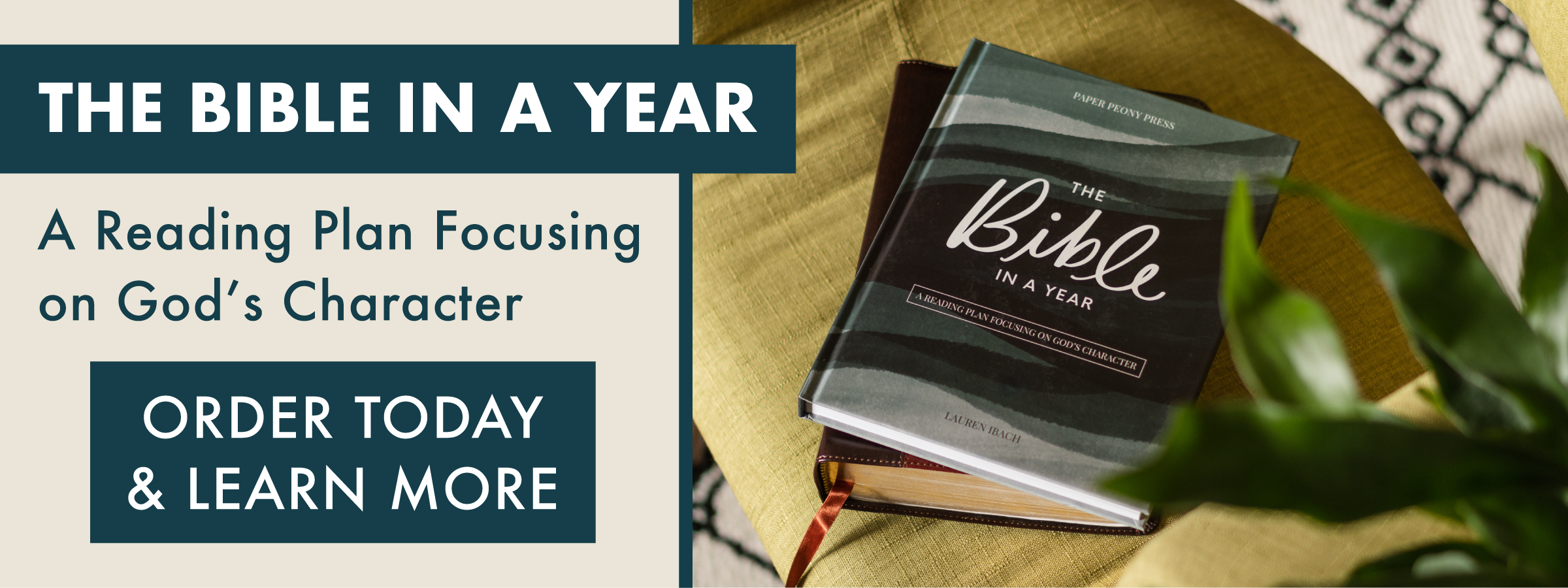
If you’ve been following my content for awhile, you know this year I’ve especially emphasized getting into the Word daily. I know many of you have made it a goal to read through the entire Bible with my book The Bible in a Year as your reading plan. And, I’ve been doing that right along with you! It has been such a blessing. But, staying disciplined while keeping the right approach has been a challenge. Would you agree? 

Today, I thought it would be helpful to talk about how to stay engaged as we read the Bible in a year. It can be tempting to just go through the motions. As a result, we forget that God is speaking to us through His Word and has so much He wants to teach us. When we lose sight of this and just power through in our own strength, reading the Bible becomes overwhelming. And, we often get discouraged or give up entirely. So, let’s talk about how to stay engaged as you read the Bible in a year.

5 Tips to Stay Engaged As You Read the Bible in a Year

Pray

We can so often underestimate the power of prayer. Do you pray before you open your Bible? Are you asking the Holy Spirit to empower you to understand what you read? That it would impact your thoughts and actions? Pause and remember that whatever passage you’re in, whether it’s an engaging historical account or an extensive genealogy—seemingly exciting or boring—it’s all God’s Word. Resist the temptation to get discouraged when struggling through a challenging chapter or section of the Bible. Trust that He is speaking through all of it and ask that He would bring understanding.

Could a lack of prayer be contributing to your struggles to stay engaged with your reading plan?

Change up the time(s) of day you read

I am currently reading the Bible using my 1-year reading plan, The Bible in a Year. It’s undated, so you can start at any time, but I started right at the beginning of the year. When I began, I would read 2-3 chapters in the morning and the rest in the evening. However, as time passed, it started feeling overwhelming to start my day with a lot of reading. And, I was struggling to stay focused. I prayed for God’s help and decided to change up my reading schedule. 

As a result, I still have quiet time in the morning and spend more of a bite-sized amount of time in Scripture at the start of my day, but I focus on getting the bulk of my reading done after dinner. I feel re-energized after a good meal, so this change has been a game changer. I’ve found as I’ve re-engaged with the reading, I am less overwhelmed and even eager for that time in the Word.

Could changing up the time of day you read help you stay engaged as you read the Bible in a year?

Schedule time in your week for deeper study

As I was reading 1 and 2 Kings, I kept thinking: 1) This has always been a challenging section of Scripture for me. And, 2) There’s a lot here that I wish I had time to study more in-depth! Then, through a class I was taking in my church, God revealed to me that there was a pocket of time in my weekly schedule that would be perfect for devoting to deeper study. So, as I read through my plan and I come across an intriguing passage or question, I write that down. Then, I save it for my special study time. A couple of my favorite things to do during this time are watching videos by the Bible Project (loved this one on Kings) and reading GotQuestions articles on Bible books or specific topics. Scheduled study time has made previously challenging sections of Scripture come alive to me. And, it motivates me as I continue reading and approach new challenges.

How might engaging in deeper study deepen your relationship with God and benefit your time in His Word?

We all have unique schedules and responsibilities. And, there is so much grace for those of us who are in seasons of life that are very full! However, we can be very good at filling our time with things we want to do, but don’t necessarily need to be doing. And, we can also be masters at making excuses for why we don’t have time for X, Y, and Z. I encourage you to pray for wisdom in this and that if God is calling you to deeper study, He would show you how and when you can schedule that time.

Jump to a different chapter

This idea came from a friend who was struggling her way through 1 & 2 Chronicles while doing The Bible in a Year plan. The idea of going out of order and skipping ahead may not appeal to you. But, consider this: If you’re really struggling to stay focused or need time to study a bit in order to better understand a section of Scripture, wouldn’t it be better to press pause on that and read a book you’re more familiar with in the meantime? The great thing about my book, The Bible in a Year, is that it’s easy to track your progress and even skip around if you need to. 

Could switching to a different section of Scripture help you stay engaged as you read the Bible in a year? If so, what might that look like for you? 

Talk about what you read

This is such a simple one, but I’ve found that talking about what I’m reading helps me remember what I’ve read and learned. This often prompts me to study more and it’s also great accountability. When we attempt to read the Bible in isolation, we are much more likely to get overwhelmed and lose heart. But, when we reflect with others on what excites or challenges us, God uses that to encourage us and spur us on.

Who could you talk to about what you’re reading in the Bible? What other benefits could talking about this have on your life or theirs?

Encouragement

I hope these brief tips will boost your motivation and help you stay engaged as you read the Bible in a year! Committing to reading the Word daily is a spiritual discipline. Therefore, we can expect days where we struggle and lack motivation. But, when we take the time to really learn and grow, God deepens our walk with Him.
If you’d like more tips on how to successfully complete a 1-year Bible reading plan, check out this post. If you’re interested in checking out my 1-year Bible reading plan focusing on God’s character, learn more about The Bible in a Year here. And of course, if you’re interested in receiving free resources to help you grow in your faith, you can receive exclusive content by subscribing to my mailing list here!


Seeing the Gospel in Our Everyday Lives

I’ve heard it said that we should preach the Gospel to ourselves daily. This can be as simple as reminding ourselves that without Christ we are dead and condemned in our sin, but by His abundant grace, Jesus died on a cross and rose from the dead to save all who repent and believe in Him. This means, all who are born again have eternal life and hope in His return. What a humbling reminder! But, preaching the Gospel to ourselves can be taken a step further when we start seeing the Gospel in our everyday lives.

As I’ve been getting into the habit of pondering and declaring the Gospel to myself daily, I’ve felt compelled to ask the Lord to give me eyes to see the Gospel in all things—even the circumstances that seem unrelated to the good news. God will, no doubt, continually be answering this prayer. But, I wanted to share with you just one of the ways He recently responded.

A personal testimony

Lately, I’ve been wrestling with feeling unequipped for ministry and the things God is calling me to in this season of my life. I’ve felt overwhelmed and insecure. And I know these feelings aren’t from God, so I went to His Word. In the Bible, the Lord promises to equip believers for what He calls us to. So, I looked for a verse that spoke truth into my insecurities and was led to Hebrews 13:20-21, which says:

“Now may the God of peace who brought again from the dead our Lord Jesus, the great shepherd of the sheep, by the blood of the eternal covenant, equip you with everything good that you may do his will, working in us that which is pleasing in his sight, through Jesus Christ, to whom be glory forever and ever. Amen.”

Hebrews 13:20-21

As I memorized these verses, truth replaced my insecurities. But the Spirit also opened my eyes to the Gospel in this passage. I could see written explicitly in the text that the Gospel is the reason it’s even possible for me to be equipped by God! When I received Christ as my Lord and Savior ten years ago, it was His death and resurrection that made forgiveness and eternal life possible. And today, Jesus remains my great Shepherd. He gives me everything I need in order to do His will and bring Him glory.

Without even realizing it when I started memorizing this passage, I was preaching the Gospel to myself! Ultimately, the answer to my seemingly unrelated insecurities was found in the hope of the Gospel.

Seeing the Gospel in our everyday lives gives us hope

I’m learning that seeing the Gospel in our everyday lives builds our faith, strengthens our hope, and gives us greater peace. The Gospel isn’t just for the moment we put our faith in Christ and one day when He returns. We get to experience the infinite blessings of the Gospel each day. Let’s pray that Jesus would give us eyes to see them and praise Him when we do.

Permissions

Unless otherwise indicated, scripture quotations are from the ESV® Bible (The Holy Bible, English Standard Version®), Copyright © 2001 by Crossway, a publishing ministry of Good News Publishers. Used by permission. All rights reserved. May not copy or download more than 500 consecutive verses of the ESV Bible or more than one half of any book of the ESV Bible.

God’s Providence

When a word, phrase, or Bible verse repeatedly pops up in my Bible studies and conversations, I’ve learned over the years to pay attention. Lately, the topic of God’s providence keeps coming up. I knew providence was somehow related to His sovereignty—which I’m familiar with—however, I wanted to learn more. I wanted to understand what is providence? Does it differ from sovereignty? And as I dug deeper, I was curious to learn how God’s providence coincides with our free will. Do you have similar questions? I hope this post will bring clarity and encourage you.

What is God’s providence?

The word “providence” is found sparingly in some English Bibles. I checked several translations on the Blue Letter Bible website and the word came up once in the KJV in Acts 24:2 and another time in the NIV in Job 10:12. Even though the word itself seldom occurs in Scripture, the doctrine of God’s providence is woven throughout the Bible. Simply put, providence is God working circumstances together to accomplish His purposes.[1] 

A biblical example of God’s providence

There are so many examples of God’s providence throughout Scripture, but one of my favorites is the story of Joseph in Genesis 37-50. Many of you are probably familiar with the story. But to quickly summarize, Joseph’s brothers sold him into slavery, which landed him in Egypt. While there, he was falsely accused of a crime and Joseph was sent to prison. After some time, he interpreted a dream of Pharaoh’s cupbearer who was briefly imprisoned. Years later, Pharaoh himself had a dream that no one could interpret, but the cupbearer remembered Joseph. By God’s grace, Joseph was able to interpret Pharaoh’s dream, which warned of a famine to come. As a result, Pharaoh made Joseph his right hand man and Joseph prepared Egypt. And when the famine came, Egypt had an abundance of food, which led Joseph’s family there. After a series of events, his relationship with his brothers was reconciled and they all moved to Egypt.

When we read this exciting narrative in the Bible, we can see that God was going before Joseph. We get to figure out the ending in just a few chapters. But, Joseph lived through abuse, slavery, slander, and imprisonment over the course of many years. After all that time of being rejected and forgotten, in the end, Joseph recognized God’s providence through it all. Genesis 50:20 sums it up so well when Joseph said, “As for you, you meant evil against me, but God meant it for good, to bring it about that many people should be kept alive, as they are today.” This is just one of the many examples of God’s providence in the Bible.

Should say, “Genesis 50:20

God’s providence in my own life

When I reflect on where I have seen God’s providence in my own life, several memories come to mind. But most recently, I witnessed His providence at work through my book, The Bible in a Year. I prayed to God that if it was His will, that He’d make a way for me to work with a publisher on a book someday. Over a year later, I was approached by my publisher, who heard about me through a connection I had made with another company. That connection was made long before I even prayed that first prayer. After all this time, I can see that God was working in and through my circumstances to accomplish His will even when I couldn’t see it. I know I’ve shared this a fair amount with my community, so sorry if I sound like a broken record! But, reflecting on His providence through this recent experience continues to leave me in awe of His sovereignty.

How does providence differ from sovereignty?

As I pondered and began studying God’s providence, I struggled to see the difference between providence and sovereignty. However, as I dug deeper, it became clearer to me that while these two truths about God are closely related, there is a distinction. I began to see that God’s sovereignty refers to His complete control over all things and His providence is the way He orchestrates all things according to His will. A wise woman in my life put it in even simpler terms: Sovereign is who He is, providence is what He does. God’s sovereign will is accomplished through His good and wise providence.

This means, God is never out of control. He is working all things together for a greater good—His perfect will. The greatest good He providentially accomplishes in the lives of believers is salvation in Christ. Looking back on my own life, I can see how God used my circumstances to communicate the Gospel message to me and prepared my heart for the day I would finally receive the good news that Jesus died on a cross and rose from the dead to save sinners. I learned that all who repent and believe in Christ as Lord and Savior are given eternal life and do not have to fear when He returns to judge the living and the dead—our salvation is secure in Him! (Mark 1:15, Acts 17:30-31, 1 John 5:11-13)

Sometimes we will get to see His providence clearly in our lives—like in the circumstances that led us to receive Christ, or experiences like what happened with my book. But, His providence goes even further beyond our individual lives, circumstances, and outcomes. Ultimately, He is sovereignly working all things together for His glory and to providentially prepare all things for Christ’s return! (Ephesians 1:11)

What about free will?

So like me, you might be wondering how God’s providence coincides with free will. While much of this remains a mystery, we do see examples of both these realities throughout the Bible. I’m sure entire books have been written on this subject alone, but I’ll attempt to put it simply here. (I encourage you to do more digging into this yourself if you have more questions!)

Simply put, God is fully in control and we remain responsible for our actions. Going back to Joseph’s story, we see this clearly. God allowed Joseph’s brothers to sell him into slavery in order for Joseph to go to Egypt and save many from the famine, and ultimately, become a foreshadowing of the deliverance that would come through Christ. Even though God used their sin to accomplish a greater good, the brothers still needed to repent of their sins. What’s incredible, is how God not only can use good in this world, but He can even take our sin and the things that fall outside of His moral will to accomplish His sovereign will.

We even see free will and God’s providence play out in Christ’s death when God used Judas Iscariot’s betrayal to send Jesus to the cross. (Luke 22:22) This was the greatest injustice of all time, yet God used it to fulfill biblical prophecy and save all who repent and believe in Him.

Clinging to what we know

This short explanation may not satisfy all of your questions on free will vs. God’s providence. However, when we don’t fully understand a biblical truth, we can always cling to what we do know: God is sovereign. This article on GotQuestions.org sums it up so well: If God is not sovereign, then He’s not really God. Why? If our free will can trump His divine providence, then who ultimately is God? We are. Divine providence does not destroy our freedom. Rather, divine providence takes our freedom into account and, in the infinite wisdom of God, sets a course to fulfill God’s will.[2]

Application

God is providentially working all things together to accomplish His sovereign will. How does the truth of God’s providence encourage or challenge you today? How might this reality cause you to think and live differently?

For me personally, the truths of God’s providence and sovereignty shape my thoughts and emotions in response to the chaos of world events. Things feel out of control, but when we cling to what we know, we can find peace in knowing God is still on His throne and He is still fully in control. We may not be able to see how, but we know that He is working all things together for His glory and for the good of those who love Him. (Ephesians 1:11, Romans 8:28) And of course, these truths increase my hope in the Gospel! Nothing can thwart God’s plan to save sinners or stop His return! He is all-powerful and true to His Word.

As born again believers, we should respond to God’s providence by:

  • Confidently trusting fully in God’s providence. 
  • Committing our works to God. (Proverbs 16:3)
  • Encouraging others with the truth of God’s providence.
  • Praying for continued dependence on God and that His will, not ours be done. (Matthew 6:9-13)[3]

If you would like to learn more on your own about God’s providence, check out the links in the notes below.


Notes:


Permissions

Unless otherwise indicated, scripture quotations are from the ESV® Bible (The Holy Bible, English Standard Version®), Copyright © 2001 by Crossway, a publishing ministry of Good News Publishers. Used by permission. All rights reserved. May not copy or download more than 500 consecutive verses of the ESV Bible or more than one half of any book of the ESV Bible.
Scripture Memory: How to Memorize Scripture

God’s Word is powerful. Have you recently experienced the power of God’s Word in your own life? Reading the Bible, studying it, and hearing sound teaching from our pastors at church on Sunday mornings are all foundational to growing in Christ. But, Scripture memory tends to be more of a challenge for many. And, it doesn’t seem to be emphasized as much as the other ways we approach the Bible, which is such a shame!

I have experienced the power of God’s Word in my own life even without realizing it at times. I recently shared about that in this video. But, a few years ago when I was in a dark season, I discovered the mighty ways God works through Scripture memory. I was working through some personal challenges and my pastor emphasized the importance of getting into the habit of memorizing Scripture. As I memorized and reflected on God’s Word in such an intentional way, by His grace, I quickly began to experience how His Word has the power to change us, and as a result, change our lives. And, I praise God that I continue to experience the power of His Word through Scripture memory today! 

So, let’s talk about why we should practice Scripture memory and how to get started.

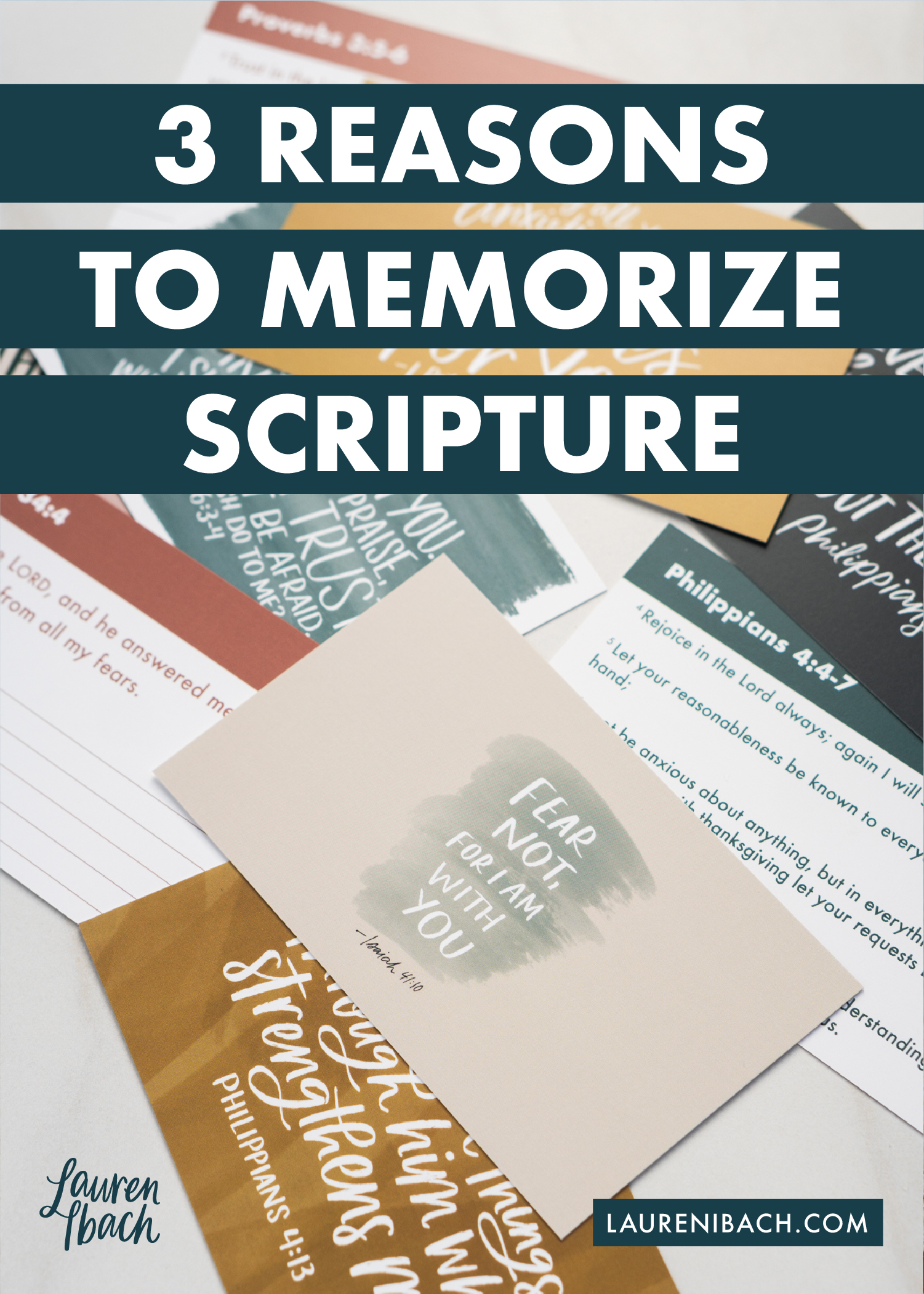
3 Reasons to Memorize Scripture

1. Scripture memory equips us | 2 Timothy 3:16-17 & Ephesians 6:10-18

2 Timothy 3:16-17 says, “All Scripture is breathed out by God and profitable for teaching, for reproof, for correction, and for training in righteousness, that the man [or woman] of God may be complete, equipped for every good work.” In other words, because the Bible is divinely inspired and given to us by God Himself, He will use it to equip us for godly living. By the power of His Word, we are able to do works that bring Him glory and benefit us and those around us.

In Ephesians 6:10-18, believers are instructed to put on the whole armor of God: The belt of truth, the breastplate of righteousness, the Gospel as shoes for our feet, the shield of faith, the helmet of salvation, and “the sword of the Spirit, which is the word of God.” Memorizing God’s Word grounds us in truth and trains us to think and act in alignment with God’s will. It reminds us of the Gospel—that Jesus died on a cross and rose from the dead to save all who repent of their sins and believe in Him. Remembering His saving work in our lives builds our faith. Knowing God’s Word is foundational to putting on the armor of God. It is our greatest defense and our weapon against the enemy and his schemes.

Key Takeaway: When we have Scripture memorized, God will use it to equip us for godly living and the battle’s we face.

2. Scripture memory shapes our thoughts and actions | Hebrews 4:12

Hebrews 4:12 says, “the word of God is living and active,” and that it discerns the thoughts and intentions of the heart. God’s Word has the power to reveal and correct wrong thinking that leads to ungodly living. As we fill our minds with Scripture, He replaces lies with truth. But, we must yield to the Spirit by trusting His promises and obeying His commands in order to experience God’s transforming work in our minds and actions. 

For example, even if we feel anxious, we still choose to trust God’s character and promises and obey His commands. If we’re memorizing Philippians 4:6-9, that means we obey God’s commands to pray and fill our minds with godly thoughts. And, we trust that He promises He will be with us and that His peace will guard our hearts and minds. 

We inform our thoughts with the truth of Scripture because while our opinions and emotions are ever changing, God’s character and promises remain unchanging. He is our reliable guide who will not lead us astray. Allowing God’s truth to guide us instead of our thoughts and feelings doesn’t typically happen overnight. It takes diligent practice and dependence on the Spirit to help us. But, praise God that He is so gracious and patient with us!

Key Takeaway: As we memorize Scripture, God speaks truth and guides us as we trust and obey what He says.

3. Scripture memory builds our trust in God | Psalm 18:30

David declares in 2 Samuel 22:31 and Psalm 18:30 that, “the word of the LORD proves true.” God proves the trustworthiness of His Word through the Bible itself. We see God’s sovereignty, promises, and prophecies fulfilled throughout generations. It’s incredible to read! And as we memorize Scripture and apply it to our lives, we get to experience His promises fulfilled in our own lives. 

One of the clearest examples of this is through the Gospel. Romans 6:23 says, “the wages of sin is death, but the free gift of God is eternal life in Christ Jesus our Lord.” When we truly believe what God says about sin, we repent and believe in Christ and His Word proves true when we receive His free gift of salvation! We are new creations (Galatians 2:20), born again (John 3:3) and experience the reality of this promise through the Holy Spirit who indwells our hearts (Romans 8:9).

By the power of the Spirit, experiencing the trustworthiness of God’s Word doesn’t stop at conversion. James 1:25 says that those who remember and follow what God’s Word says will be blessed. We have countless opportunities to put our faith into action. And as we witness the work God does as we align ourselves to what His Word says, our trust in Him increases.

Key Takeaway: God’s Word is proven true throughout the Bible and in our own lives. Scripture memory increases our trust in Him as we live in light of His promises.

How to Start Memorizing Scripture

Scripture memory equips us, shapes us, and builds our trust in God and His Word. So, let’s talk about how to start memorizing Scripture so that we can experience these blessings.

6 Tips to Help You Start Memorizing Scripture

1. Be prayerful.

We must be prayerful as we memorize Scripture, asking the Spirit to write His Word on our hearts and live in light of what’s true. When we attempt to do this in our own strength, it becomes burdensome. But, when we are dependent on God as we memorize, we trust He will do a mighty work in us.

2. Choose a verse or passage.

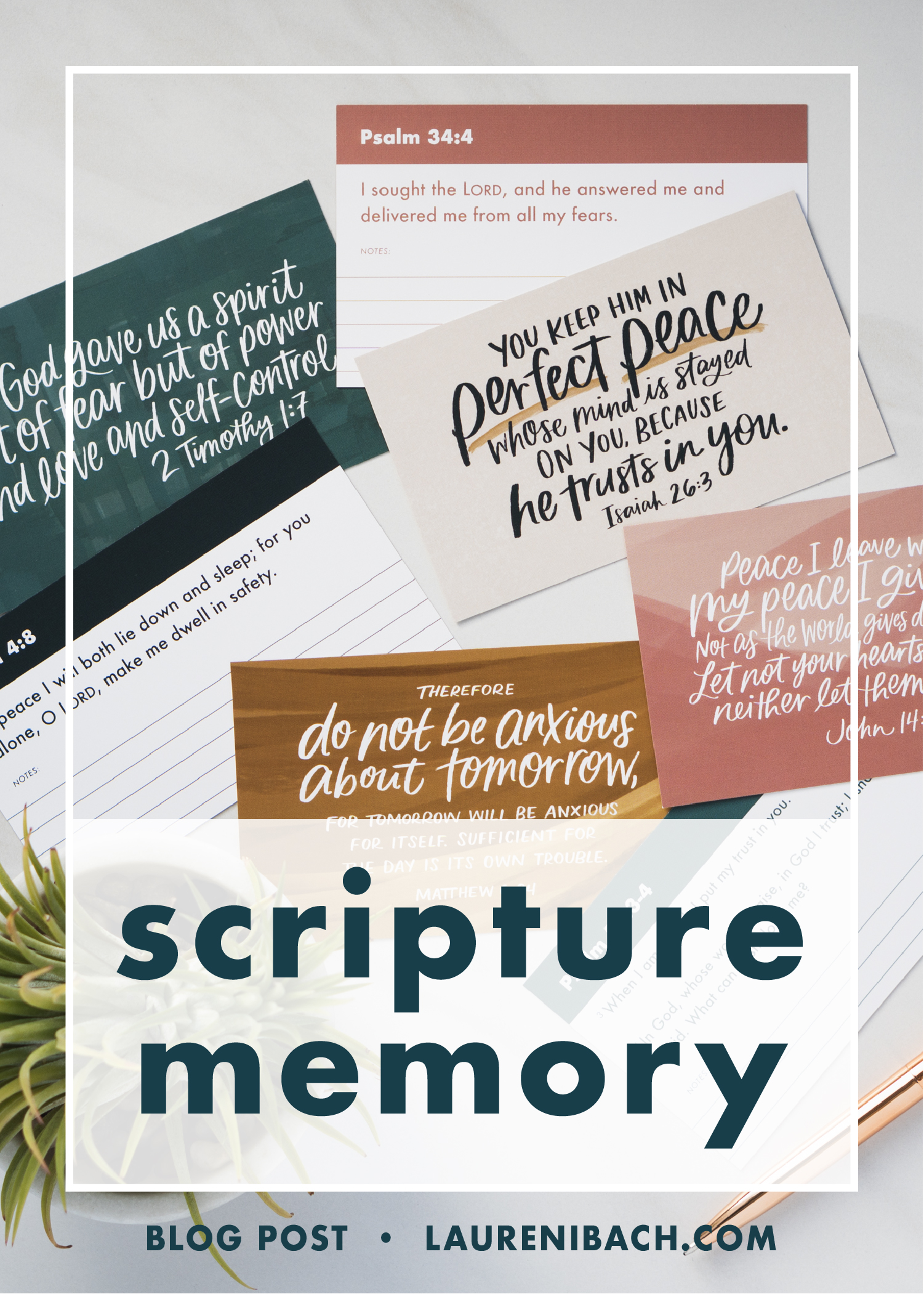
Simply open the Bible and choose a passage! But, if you are looking to memorize passages that speak truth into specific topics, there are so many resources out there to point you in the right direction. My Scripture memory cards (pictured below) are a great option! But, books like The Topical Memory System and God’s Promises for Your Every Need are also helpful resources. (Need help choosing a Bible translation? Click here!)

3. Figure out a system that works for you.

When will you dedicate time to memorizing Scripture? How often will you memorize new passages? How will you go about it? Writing your verses down where you can easily reference them, is so helpful. I write passages I’m memorizing in a small notebook and on notecards that I can easily carry with me wherever I go. I designed my Scripture memory cards as individual 3×5” cards so they could be carried in your purse, used as a bookmark for your Bible, displayed on your desk or bedside table.

4. Incorporate the passage in your quiet time.

It’s important to take time to meditate on the Scripture we’re memorizing during our quiet time. This means we actively study it to deepen our understanding of what God is saying in the passage. A great way to start is by reading the surrounding verses or entire chapter for context. And, we incorporate the passage in our prayers. How can you praise God for the truths in the verse(s)? What can you thank Him for? Does it prompt you to confess any sin? How do the truths of the passage impact your prayers as you bring your concerns and requests to God?

5. Apply it.

We talked about this a fair amount already, but again, trust what God’s Word says and pray for the Spirit to empower you to obediently live it out. James 1:22 says to be doers of the Word and not just hearers. When we memorize without action, we are only building up head knowledge.

6. Review it.

As you memorize more and more Bible verses, don’t forget to review the passages you memorized in the past. Reviewing keeps God’s Word fresh in our minds and God uses what we’ve memorized to minister to us and others!


I hope this post got you excited about Scripture memory! Visit my Scripture Memory Hub for more tips and tools!

If you’d like more resources and exclusive content to help you grow in your faith, join my mailing list. To start, I’ll send you a free e-devotional!


Permissions

All scripture quotations are from the ESV® Bible (The Holy Bible, English Standard Version®), Copyright © 2001 by Crossway, a publishing ministry of Good News Publishers. Used by permission. All rights reserved.

My Faith Story and Creative Journey

Recently, I was invited by a group of young moms at my former church to share my faith story and creative journey. This week marks 10 years since I received Christ as my Lord and Savior so, it was a blessing to have an excuse to sit down and do some deep reflecting. In addition, it was a joy and privilege to share with others just a handful of ways God has been at work throughout my life.

God is so faithful and His Word is so powerful. I hope you will be encouraged by the story He has given me and that it will prompt you to think about how God has been at work throughout your unique story. All glory to Him!

My Faith Story and Creative Journey | Audio


Application Questions

  • Can you think of a specific moment or season you received Christ as Lord and Savior? If so, how has your life changed since then? If not, why might that be? Are you sure you have put your faith in Christ?
  • How might you be looking to the world for wisdom instead of God and His Word?
  • Are you living a life dependent on God?
  • How might God be leading you to grow in dependence on Him?
  • How have you seen God at work in your unique story?

Key Verses

“Trust in the LORD with all your heart and do not lean on your own understanding. In all your ways acknowledge him and he will make straight your paths.” –Proverbs 3:5-6

“Commit your work to the Lord and your plans will be established.” –Proverbs 16:3

“I am the vine; you are the branches. Whoever abides in me and I in him, he it is that bears much fruit, for apart from me you can do nothing.” –John 5:15


Permissions

All scripture quotations are from the ESV® Bible (The Holy Bible, English Standard Version®), Copyright © 2001 by Crossway, a publishing ministry of Good News Publishers. Used by permission. All rights reserved.

What is Repentance?

“Repent and believe in the gospel.” I often reference these words spoken by Jesus in Mark 1:15 when talking about what we must do to be saved. Many may ask, what is repentance? I’ve heard it said that belief and repentance are two sides of the same coin. Saving faith in Christ requires both. True belief always results in repentance. You can’t have one without the other. But, there is a lot of confusion about what it really means to repent. I hope to bring some clarity to those questions today.

What is repentance?

According to Easton’s Bible Dictionary on BlueLetterBible.org there are three Greek words in the New Testament referring to repentance. The verb metamelomai is used to indicate a change of mind which results in regret over sin, but not a change of heart. Judas in Matthew 27:3 exemplifies this false kind of repentance.

The verb metanoeo and its related noun metanoia refer to changing one’s mind and purpose. These words signify true repentance – the kind of repentance that changes the heart and results in saving faith. Todd Friel said it so well in a recent episode of his podcast Wretched: “Repentance isn’t a mere changing of the mind. It’s a changing of the will, the emotions, our thinking, and our attitudes.”

To put it simply, the repentance Jesus commands is more than mere regret. Genuine repentance means we are remorseful over our sin and recognize our guilt before a holy God and righteous Judge. When we truly repent, we turn from our sinful thoughts and actions, and instead, align our hearts to God and His Word.

Is repentance a work?

Ephesians 2:8-9 says, “by grace you have been saved through faith. And this is not your own doing; it is the gift of God, not a result of works, so that no one may boast.” (emphasis added) The Bible makes it clear that works do not save us. However, many mistake repentance as a work, which leads to understandable confusion. This topic alone could be an entire blog post, but to put it simply, repentance is not a work. Jesus alone does the saving. But how is that possible when repentance is required for salvation, you might ask?

This simple analogy I found on GotQuestions.org explains this so well:

“Suppose someone anonymously sent you a check for $1,000,000. The money is yours if you want it, but you still must endorse the check. In no way can signing your name be considered earning the million dollars—the endorsement is a non-work. You can never boast about becoming a millionaire through sheer effort or your own business savvy. No, the million dollars was simply a gift, and signing your name was the only way to receive it. Similarly, exercising faith is the only way to receive the generous gift of God, and faith cannot be considered a work worthy of the gift.”

GotQuestions.org | Article: “How can salvation be not of works when faith is required?

Faith – which requires belief and repentance – is how we receive God’s gift of grace. Christ’s work on our behalf is the only work necessary for salvation and He was the only one able to accomplish that work on our behalf.

How does one repent?

We’ve answered the question, What is repentance? Now we know that by definition, repentance requires a complete change of heart and mind. It’s not a work that earns us salvation. So, now we must ask the question: How does one repent?

Believe

Repentance and belief go hand in hand. True belief results in repentance. In other words, we cannot repent in our own strength. We must believe in the Gospel of Jesus Christ, because it’s His kindness that leads us to repentance. (Romans 2:4)

The Gospel is the message that we are all born sinners in need of forgiveness and no amount of good works can erase our guilt before God. The Bible teaches that there is no forgiveness without the shedding of blood and that the righteous and just penalty for sin is hell. But the good news is that out of His great love for unworthy sinners, Jesus Christ, both fully God and fully man, died on a cross and rose from the dead to pay the penalty for our sins. Jesus said in order to be forgiven, we must repent, believe, and receive Him as Lord and Savior. By grace, through faith in Christ, we have assurance of salvation and eternal life! Those who are saved are born again – we are new creations and are given the gift of the Holy Spirit who dwells in our hearts permanently.

Do you believe in the Gospel and what Christ has done on your behalf? If so, how does that impact your life? If not, I encourage you to put your faith in Him today. He is worthy of our complete trust! What might be keeping you from believing in Him today? I encourage you to surrender that to Jesus in faith.

Confess

Repentance requires confession. When we genuinely believe in the Gospel, we confess our guilt as sinners directly to God. We don’t minimize our sins or make excuses. True confession means we are in complete agreement with God about our sin. It also means that we recognize that we are unable to get right with God by our own efforts – no amount of good works can erase our guilt. When our confession is genuine, we recognize sin’s seriousness while trusting Jesus is faithful to forgive us and cleanse us from all unrighteousness. (1 John 1:9) Trusting in Jesus’ mercy and grace leads us out of our old patterns of thinking and living and into a new life lived according to the will of God.

Have you confessed your sin to God? If so, how has your life changed as a result? If not, what might be keeping you from doing so? Will you ask God to align your heart to what He says about sin?

Receive

When we believe in Christ alone, confess our sin, and commit to living for Him, we can receive Him as our Lord and Savior! Receiving Christ means we trust that Jesus has paid for all of our sins – past, present, and future; sins committed intentionally and unintentionally. To receive Jesus is to let go of all the other things we once put before Him – the idols of our lives. It means we trust Jesus is who He says He is and cling to all He says is true. When we receive Christ, the Holy Spirit comes to dwell in our hearts – we are born again and become children of God. 

When we receive Christ, we don’t simply add Him to our lives. He becomes the center of our lives. We still sin on this side of heaven, but we don’t go back to our old ways of living. The Holy Spirit continues to lead us in repentance. By His power, our lives are transformed and we are increasingly made more like Christ. This process is called sanctification.

Our response

When we receive Jesus as Lord and Savior our initial response should be praise and worship! We praise Him by declaring who He is and what He has done. Worship can happen in a variety of ways. We can worship Him with songs on Sunday mornings among other believers, but we also worship Him in our everyday lives. Whatever we do, we are commanded to do all to the glory of God. (1 Corinthians 10:31) We learn what that looks like through prayer and careful study of the Bible. God wants a relationship with us and He communicates with us in these ways.

Can you remember a specific moment or season you received Christ as Lord and Savior? If so, what was your response and how might God be leading you to continue responding? If not, why might that be? Are you sure you have put your faith in Christ? If you are unsure, I encourage you to pray. Ask God to reveal the truth about your relationship with Him. Read the Bible to discover who He is and what He says about salvation. I recommend starting in the book of John.

The importance of repentance

I hope this post answered the question “What is repentance?” in a clarifying and encouraging way. It’s important to understand repentance for salvation. But, it’s also important to know how to articulate to others what true repentance looks like. There are many people – including professing Christians and church goers – who don’t understand this important doctrine. We must emphasize repentance and belief in the Gospel when ministering to others. Talking about sin can be awkward and uncomfortable. But, receiving Jesus is a matter of one’s eternal destiny. Gently speaking the truth about sin and our need to repent is the most loving thing we can do for others.


Permissions

All scripture quotations are from the ESV® Bible (The Holy Bible, English Standard Version®), Copyright © 2001 by Crossway, a publishing ministry of Good News Publishers. Used by permission. All rights reserved.